



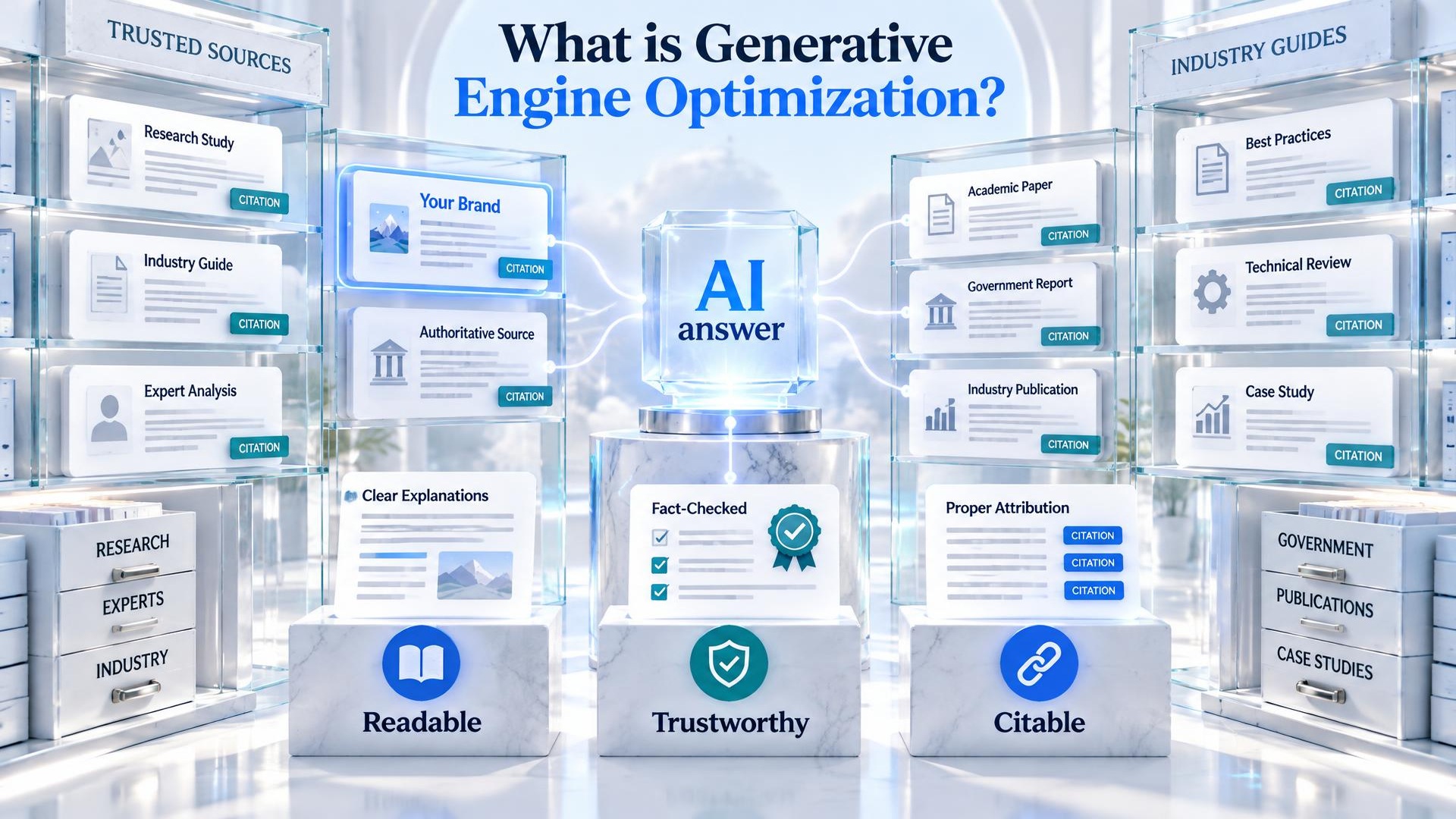
What Is Generative Engine Optimization (GEO)?
Generative Engine Optimization (GEO) is the practice of making a brand's website, data and content readable, trustworthy and citable to AI systems such as ChatGPT, Gemini, Perplexity and Google AI Overviews. Where SEO earns ranked links, GEO earns inclusion inside the AI-written answer itself.
Generative engines use large language models (LLMs), often paired with retrieval-augmented generation (RAG), to pull passages from web sources and compose one synthesized response. A buyer who asks which agencies help small businesses rank in AI search receives a short list of named companies, not a page of links. GEO is the work of becoming one of those named sources.
How Is GEO Different From Traditional SEO?
Traditional SEO optimizes pages to rank in a list of links, while GEO optimizes content and entity data so AI engines can extract, verify and cite it in a synthesized answer. The two overlap heavily, and strong SEO fundamentals remain a prerequisite for most GEO work.
| Factor | Traditional SEO | GEO |
|---|---|---|
| Goal | Rank a page in search results | Be cited or named in an AI-generated answer |
| Unit of success | Position and click-through rate | Citation frequency and accuracy |
| Content style | Keyword-targeted pages | Answer-first passages under question headings |
| Identity signals | Google Business Profile, backlinks | Entity markup, consistent data across directories |
| Technical focus | Crawlability, speed, meta tags | Crawlability plus JSON-LD schema and optional llms.txt |
| Measurement | Rankings, organic traffic | Prompt-based citation tracking, visibility score |
Why Does GEO Matter for Businesses?
Customers increasingly ask AI tools conversational questions about products, services and providers, and receive one synthesized answer instead of ten links. A brand missing from the sources those engines use is absent from that decision. Published estimates of AI use for research vary, so verify figures before citing them.
- Fewer clicks, more answers: AI Overviews and chat assistants resolve many questions without a click to a website. [CITATION NEEDED: current percentage of adults using AI tools for product and service research]
- Higher-intent visitors: Buyers who arrive after an AI recommendation have already seen the brand named as a relevant option.
- Compounding effect: Each optimized page, corrected listing and new authoritative mention adds to a source pool that persists.
How Do AI Engines Decide Which Brands to Cite?
AI engines favor sources that show verifiable expertise, consistent identity data across the web, and deep coverage of a topic. That means named authors, accurate business listings, structured data and comprehensive content on the subjects a brand wants to be known for.
- 1.E-E-A-T signals. Google's Experience, Expertise, Authoritativeness and Trustworthiness framework is widely treated as a proxy for whether a source is safe to cite. [CITATION NEEDED: study on share of AI-cited sources showing strong E-E-A-T]
- 2.Entity consistency. Engines cross-reference a business's name, address, phone number (NAP), services and credentials across Google Business Profile, review sites, directories and its own website. [CITATION NEEDED: data on citation lift from consistent entity data]
- 3.Topical authority. Brands that publish comprehensive, well-structured content on their core subjects are more likely to be retrieved than brands with thin pages. [CITATION NEEDED: data on citation lift from topical content clusters]
What Does a GEO Program Include?
A GEO program combines six workstreams: entity markup and schema, topical content clusters, cross-platform data consistency, E-E-A-T documentation, technical auditing and AI citation monitoring. An llms.txt file is an optional addition. Each workstream removes a specific barrier to being found, understood or trusted by AI systems.
| Component | What it does | Typical deliverable |
|---|---|---|
| Entity markup and schema | Tells machines who the business is and what it offers | JSON-LD using schema.org types such as Organization, Service and FAQPage |
| Topical content clusters | Builds depth by service and subject | Guides, comparison pages, FAQ clusters, explainers |
| Cross-platform consistency | Removes conflicting data | Audited, corrected listings across directories |
| E-E-A-T documentation | Shows verifiable expertise | Author pages, cited sources, client results where permitted |
| Technical GEO audit | Finds crawl and markup problems | Report on slow pages, meta tags, missing schema and crawlability |
| AI citation monitoring | Measures visibility | Monthly report of mentions across ChatGPT, Gemini, Perplexity and Claude |
What Is an llms.txt File, and Does It Help With AI Visibility?
An llms.txt file is a markdown guide hosted at a website's root that summarizes key pages and facts for AI crawlers. Google does not use it for ranking, and support among AI platforms varies, so treat it as a low-cost accuracy aid rather than a visibility guarantee.
The file lists clean, markdown-formatted summaries of services, expertise and policies, so a crawler does not have to interpret complex HTML. [CITATION NEEDED: vendor documentation confirming which crawlers read llms.txt]
How Should a GEO-Ready Article Be Structured?
A GEO-ready article opens with a 40-to-60-word direct answer, uses question-style headings, cites credible sources, and adds structured data. Each of these elements makes it easier for a language model to extract and correctly attribute one accurate passage from the page.
- Answer-first writing (BLUF): Put the direct answer in the first lines of the article and of every major section.
- Credible sourcing and statistics: Link to studies and recognized bodies, and name the source in the text.
- Internal and external links: Connect related pages and link out to authoritative references.
- Image alt text and semantic keywords: Describe images accurately and cover related terms and entities.
- Meta tags and JSON-LD schema: Write a precise title and description, and mark up the page, author and FAQ.
How Do You Measure GEO Results?
GEO success is measured by citation frequency, the share of AI answers that mention the brand, the accuracy of how it is described, and downstream actions such as calls, leads and sales. Track a fixed prompt set monthly across ChatGPT, Gemini, Perplexity and Claude to compare trends.
| Metric | What it shows | How to collect it |
|---|---|---|
| Citation frequency | How often the brand is named or linked | Run a fixed list of customer prompts monthly and log results |
| Share of answer | Presence versus competitors in the same prompts | Compare named brands per prompt |
| Description accuracy | Whether services are stated correctly | Review each AI answer against verified facts |
| Referral traffic | Visits from AI platforms | Analytics referral sources |
| Conversions | Calls, form fills, purchases | Call tracking and form tracking |
Frequently asked questions
Is GEO the same as SEO?
No. SEO earns ranked links in search results, while GEO earns mentions and citations inside AI-generated answers. They share foundations such as crawlable pages, quality content, schema and consistent business data, so most businesses benefit from running both programs together rather than choosing one.
How long does GEO take to work?
AI citation authority builds gradually, and many programs report durable results over several months rather than weeks. Timing depends on the brand's current content, listing accuracy, site authority and competition, so progress is best judged by tracking the same set of customer prompts every month.
Which AI platforms should a business optimize for?
Start with ChatGPT, Google AI Overviews, Gemini and Perplexity, then add Bing Copilot and Claude. Most of the work, including schema, content depth, authoritative mentions and consistent listings, applies to all of these platforms at once, so there is no need to build a separate program for each.
Does a business need an llms.txt file?
It is optional. Google does not use it for ranking, and support varies by AI platform, but the file is inexpensive to create and maintain. It can improve how accurately AI tools describe a business's services, credentials and policies when a tool chooses to read it.
Request a free review